
Naming Rights: Heinen’s on the Label Means Quality Inside

This article was written by Heinen’s Partner, Elaine T. Cicora.
It’s been nearly a century since Joe Heinen launched his butcher shop in Shaker Heights, and a lot of things about Northeast Ohio’s iconic grocer have changed in that time. Twenty-four locations? Tens of thousands of products? And the wonders of online shopping? Joe probably never saw that coming.
Yet some things haven’t changed a bit – including Heinen’s dedication to quality. “You have to find the best to sell the best,” was how Joe put it back in 1929. And today, that philosophy continues to be reflected throughout the entire enterprise.
Consider Heinen’s private brands program, for example. Led by program director Nathan Perc, a 19-year Heinen’s veteran, the initiative brings together store managers, product manufacturers, local and national vendors, and corporate chef Jacki Novotny, to develop, test, taste, label, and bring to market the Heinen’s branded products that shoppers love.
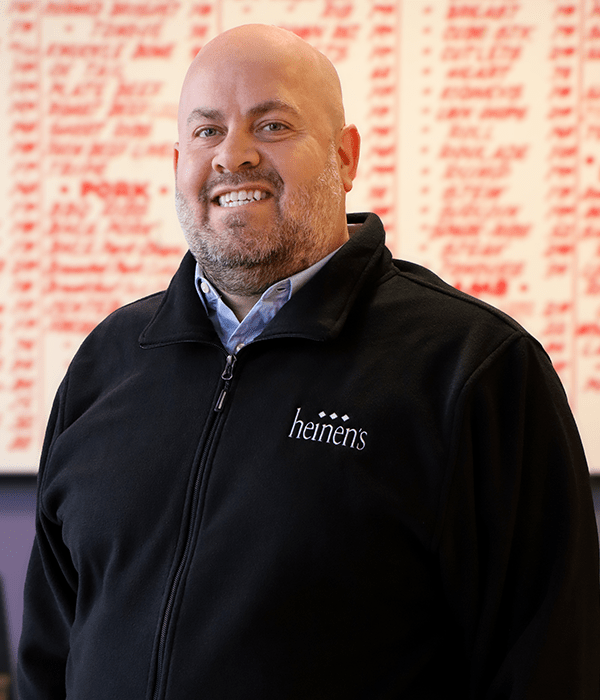
Shoppers will currently find between 1,200 and 1,300 items, mainly in the grocery, dairy, and frozen-foods aisles, that proudly carry the Heinen’s name. Bringing these products to market comes with myriad moving parts, Nathan says, especially when it comes to balancing Heinen’s strict quality standards against product pricing. The goal, always, is to offer a product as good as – or better than – the national brands while saving shoppers money.
“To launch a new item, the stars really have to align,” says Nathan, “and everything has to match up in terms of quality and pricing opportunity.”
Heinen’s exacting quality standards mean crafting products that taste delicious while containing no artificial flavors, synthetic colors, artificial sweeteners, or preservatives – other than ingredients like salt, which Nathan explains, sometimes can serve as a natural preservative.
Product recipes come from several sources, all of which must clear Heinen’s highest bar. Some recipes are industry standards, like the ones for cheese sold in the dairy aisle. Heinen’s branded ketchup was developed to mimic national brands while offering a “cleaner” ingredient panel.
And still other recipes are crafted and curated by Nathan, Chef Jacki, and their teams, including the popular line of Two Brothers Seasonings, in such varieties as Blackened, Seafood, Prime Rib, Sweet & Smokey, Steak & Burger, Everything Bagel, Chipotle-Orange, and the Original All-Purpose Seasoning. As savvy shoppers know, the Two Brothers label, with its pair of outlined profiles, represents Jeff and Tom Heinen, the third generation of this family-owned and operated business. That label serves as yet another assurance of Heinen’s commitment to sourcing top quality products.
“We could make more money if we were willing to slap our name on anything,” Nathan shares, “but that’s not the Heinen’s way. ‘You have to find the best to sell the best’ remains our core philosophy, because without those high standards, we know we would lose our customers’ trust.”
While more than a thousand products bear the Heinen’s label, a select number of them have earned the designation of “fan favorites”: products that are perennially among the grocer’s top sellers.
Beyond the highly successful line of Two Brothers Seasonings, that lauded list includes Heinen’s branded small-batch kettle chips, bottled organic teas and lemonades, and versatile frozen flatbread pizzas, made from recipes developed in concert with the manufacturers in varieties including Pepperoni Duo, Four Cheese, and BBQ Flavored Chicken.
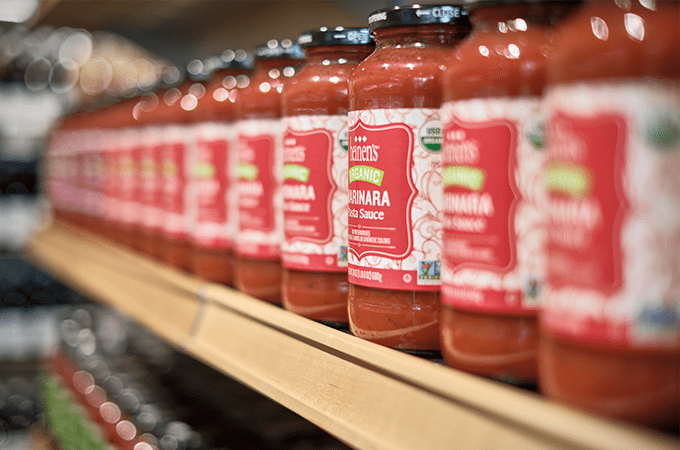
“The old perception of private-label products was that they offered lower prices than the national brands, but not the same quality,” Nathan says. “But our shoppers have learned that Heinen’s is first and foremost about quality; they reach for our product knowing they’ll get the same flavors and the same quality as the national brand they know and love – in fact, often made by the same manufacturer – all while saving money.”
“I mean, why wouldn’tyou try those products?”
Key to maintaining the highest standards, of course, is Heinen’s relationship with their manufacturers.
“We’re on a very personal basis,” Nathan says. “The Heinen’s name holds a lot of credibility in the industry and allows us to collaborate very closely with our partners to really dial in the details, sharing input and calling on the talents of Heinen’s culinary team members.”
That’s especially valuable when it comes to tweaking flavor profiles, Nathan says. In fact, he and Chef Jacki may go through more than a dozen iterations of some recipes, as they move from small samples to 500-gallon batches, all to make the product as “clean,” flavorful, and appealing to shoppers as possible. “I think I have a pretty good palate,” Nathan says,” but I can’t hold a candle to Chef Jacki. She really knows how to use a spice cabinet!”
Beyond yielding prime flavors, that sort of careful recipe development also aims to build trust. Whether it reads “gluten free,” “non-GMO,” “organic” or others, a Heinen’s label will only make claims that its vendor is certified to uphold.
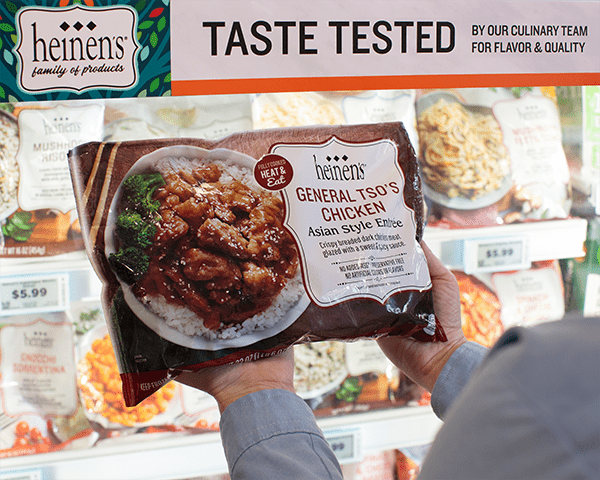
“More than ever, I see shoppers reading the ingredients panels before they buy,” says Nathan. “We want to put those product claims right on the front of the package. We want shoppers to know they don’t have to read the fine print. If we make a claim on the label, you can trust it, 100%.”
Among the program’s many vendors, some are small, local businesses, which gladly custom formulate recipes to Heinen’s specifications. Conventional and organic milk, cottage cheese, packaged cheeses from the dairy aisle, ice cream, fresh salsas, bottled Asian sauces, ketchups, mustards, nuts and bulk coffees are among the locally manufactured items that boast the Heinen’s label.
Nathan is particularly proud of the quality of Heinen’s branded coffees – including bulk, K-cups, and – coming soon – bagged beans. Sourced and roasted to Heinen’s specifications by a small, family-owned business in Brecksville, Ohio, the beans arrive in the stores within hours of roasting. “We open the bags, put the beans in the bins, and customers take them home. It really doesn’t get any fresher than that!”
Of course, Nathan cautions, not all relationships are forever. Especially in a time when manufacturers are being pressured to maintain the highest possible profit margins, producing a particular Heinen’s branded product might prove unfeasible due to pricing.
“I know 24 stores sounds like a lot,” he explains, “but in all honesty, we are still a fairly small operation. If we can’t balance our volume, minimum order quantities, and pricing versus the cost of a national brand, we won’t offer that item.
“But I promise: We don’t just take customers’ favorite products off the shelf! Those decisions are nearly always unfortunately driven by the manufacturers.”
Nathan emphasizes that both he and the entire Customer Relations team are always eager for feedback. “Heinen’s is a family-owned-and-operated company, and our teams tend to be small, so we all wear many hats. That gives us a lot of autonomy and a real sense of ownership in our departments. I look at my job as if it were my very own business: If something works, if it doesn’t work, or if someone has questions, they come to me—and I genuinely care about their feedback.”
After all, he says, his goal is to ensure that Heinen’s branded products are created, curated, and manufactured to meet shoppers’ highest expectations. “Our customers mean the world to us,” Nathan says, “and we want to see our private-label products in their cabinets, in their refrigerators, and on their countertops – so they can tell their family and friends just how much they love them.”
And with Heinen’s labeled products representing average savings of around 25%, compared to the national brands, why not?
“You know that can of beans you see sitting on the shelf next to the national brand?” Nathan asks. “It’s less expensive, every bit as good — and the reality is, it’s ours.”
“Great products at a great price: We believe Heinen’s branded items are win-win for everyone.”